
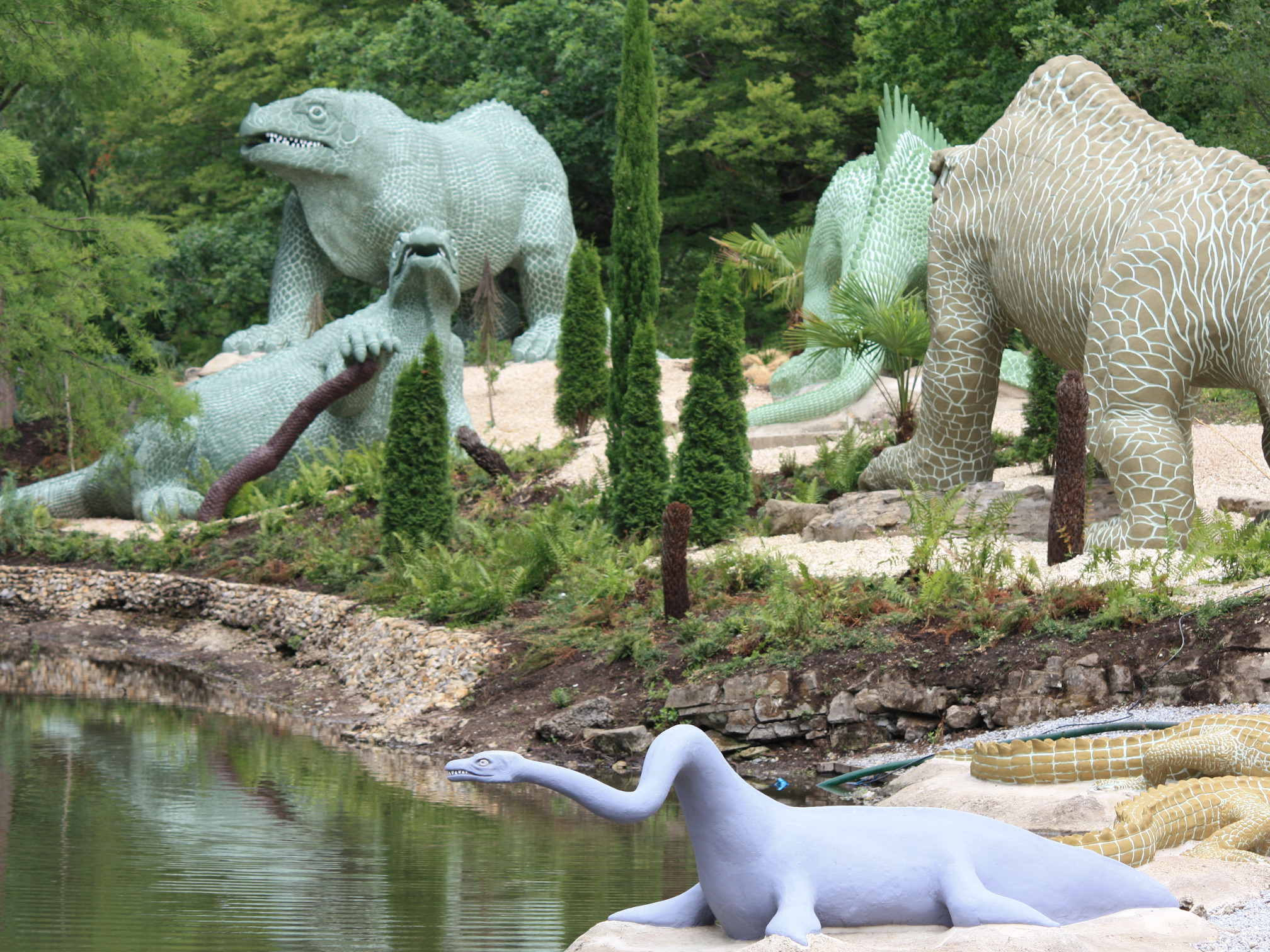
On the Secondary Island (representing the “Mesozoic” Era) the prehistoric reptiles are all on or around rocks representing strata where their fossils were discovered. There are also a few scattered replica ammonites and cycad plants on the island.
These illustrations represent geological formations from southern England. You can see in sequence from south to north:
New Red Sandstone: From the Triassic (251-201 million years ago), the first period in the Mesozoic. These small cliffs, located near the Dicynodon, are the largest surviving original Secondary Island illustration. They represent a desert environment during this period of British geological history.
Lias Cliff: A simulated Early Jurassic (201-174 million years ago) limestone cliff represents a tropical sea that once covered most of what is now southern England. These were the same formations where Mary Anning collected fossils in the early-19th century, including those of the ichthyosaurs and plesiosaurs located next to it.
Oolitic Limestone: These are rocks from the Middle Jurassic (174-163 million years ago), when Britain was a series of shallow seas and tropical islands. The Megalosaurus is surrounded by limestone which is from the Cotswolds, a stone used locally for building.
Wealden Sandstones: The sandstone blocks around the Iguanodon and Hylaeosaurus represent the geology of Sussex, where some of the first dinosaur fossils were found. They are from the Early Cretaceous (145-100 million years ago), but were considered Jurassic by the geologists building the Geological Court.
Chalk: A simulated chalk cliff, with Pterosaurs perched on it, illustrates the Late Cretaceous (100-66 million years ago), the final major division of the Mesozoic. It represents a deep sea, through which swam Mosasaurus.
Ammonites: Three (inaccurate) ammonite sculptures were added as part of the 2001 reconstruction. These presumably were meant to be Late Cretaceous (100-66 million years ago) given the location on the north slope of the Mesozoic island. However, they appear to have been constructed from sets of fragments of ammonites of different species and so may be remains of specimens of almost any age.
Cycads: There is a mix of fibreglass (2001) and concrete (Victorian) cycad sculptures on the Mesozoic island, as well as living Cycas revoluta plants. A total of 8 cycad sculptures were recorded in April 2022. These plants represented the Late Mesozoic (145-125 million years ago).
Last edited on 3 July 2026
Registered Charity 1165231 (England and Wales)
© Copyright Friends of Crystal Palace Dinosaurs, 2013-2026. Privacy policy.
Hosted on a server powered by 100% renewable energy.
 Follow us on Bluesky
 Like us on Facebook