
The Tertiary Island and neighbouring Quaternary display feature the least developed illustrations, as many of the intended developments of this part of the park were never completed.
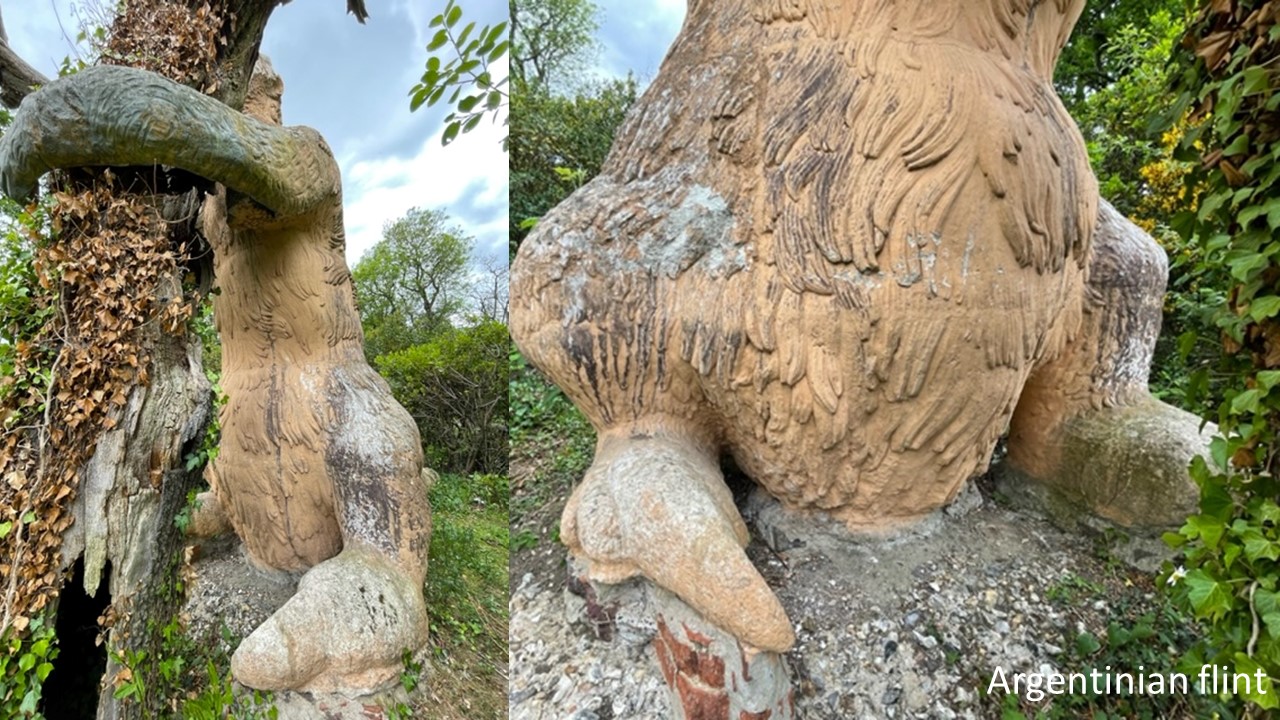
On Tertiary Island, there are two illustrations, which are both visible from across the water. The Giant Ground Sloth Megatherium sits atop a larger flint structure representing the Quaternary (2.5 mya to present) geology of the Pampas (large open plains) in Argentina, where Megatherium fossils are found.
On the opposite side of the island, below the Palaeotherium and Anoplotherium mammal sculptures, the edge of the Tertiary island is formed by a flint aggregate. This represents the lower Tertiary (‘Palaeogene’ in modern terms: 66-23 mya), a warm period that followed the extinction of (non-bird) dinosaurs.
The largest, best preserved and most accessible of the flint displays occurs under the Megaloceros (“Irish Elk”) statues. These feature river gravels from the London Basin representing the interglacial periods (warm periods during the Ice Age), where fossils of animals like Megaloceros are found, and are widespread in London’s Thames Basin. The display is nicely detailed, including cross-bedding and channel structures almost certainly modelled on a real outcrop.
The Thames Basin gravels were sourced locally, reminding us that Crystal Palace Park itself is built over interesting geology. Underneath the park are sand and clay deposits of the Palaeogene London Clay, formed when the Palaeotherium and Anoplotherium lived. These were shaped into the islands and rises comprising the Geological Court.
Last edited on 25 July 2023
Registered Charity 1165231 (England and Wales)
© Copyright Friends of Crystal Palace Dinosaurs, 2013-2026. Privacy policy.
Hosted on a server powered by 100% renewable energy.
 Follow us on Bluesky
 Like us on Facebook