
Scientific name: Xiphodon gracilis (formerly Anoplotherium gracile)
Common name: Xiphodon
Lived: In warm temperate to subtropical forests in Britain and mainland Europe
When: During the Eocene epoch, 40.4 - 33.9 million years ago
Size: An extinct, camel-like two-toed animal with slender legs and small canine teeth.
Diet: Plant-eating browser, mostly consuming leaves and fruit
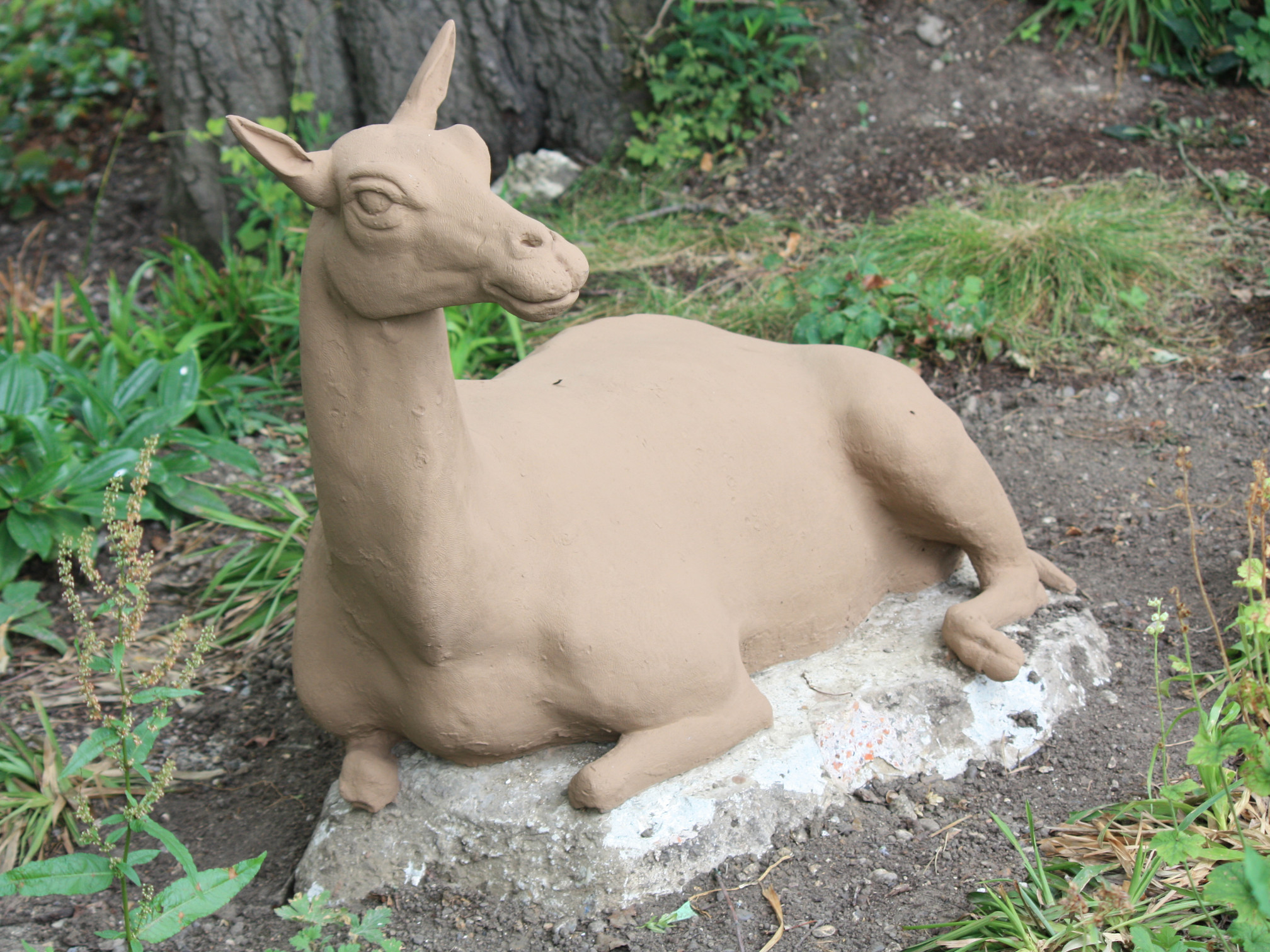
Statues: Xiphodon is a very recently discovered animal at the Crystal Palace Park site. For years one of the statues has hidden in plain site, thought to be a giant deer (Megaloceros) fawn, and placed with these animals in the heather on the Quaternary island.
In 2021, whilst undertaking research for the new book, Friends of Crystal Palace Dinosaurs realised that this baby ‘deer’ actually displayed more camel-like features, including its large cleft lip and long neck, and appeared misplaced among the deer. In fact it looked much more similar to the Anoplotherium on the Tertiary island and was suspected that it was actually a more slender form of these animals, known as ‘Anoplotherium gracile’, now referred to as Xiphodon gracilis.
This prompted us to search archival material for more evidence of its historical presence at Crystal Palace Park. To our astonishment we realised it was originally one of four such animals, featured in sketches from Benjamin Waterhouse Hawkins’ worskshop from the 1850s (the individual lying down at the front left, seen in the black and white image above). None of the other three Xiphodon sculptures have been found and their whereabouts remain unknown.
Written works corroborate their existence, too. Several articles and guidebooks mention four antelope- or camel-like sculptures that, as described, do not match the other species depicted in the park. McDermott’s (1854) Routledge’s Guide mentions ‘four graceful llama-like’ Anoplotherium sculptures (p.192) and an 1854 Hogg’s Instructor article describes them as ‘like a number of antelopes or deer’ (p. 285). Official park guides, including corrected and updated versions released after the park opened, also continually mention the presence of ‘Anoplotherium gracile’ (e.g. Phillips, 1855, 1856), with one – the anonymous 1871 edition – giving their location as ‘under a tree’.
The Crystal Palace statues vs modern scientific reconstructions: As with most of Hawkins’ mammal sculptures, his ‘A. gracile’ work has stood the test of time. Today, we would reconstruct this species broadly as he did, with our main distinctions incurred through modern ideas of where Xiphodon fits among mammalian evolution.
The 1854 illustration and the surviving sculpture suggest they were authentic takes on the anatomy of Xiphodon as known in the mid-1800s, and closely based on the famous scientist Cuvier’s pioneering skeletal studies. It seems all four sculptures had the same body plan without, as is seen in some of the other mammals, obvious sexual dimorphism (differences between males and females). Their bodies look well-muscled but they were not cast as especially bulky or heavyset creatures, meeting early interpretations of this species as a fast runner (Owen, 1846; Rudwick, 1997). The camel-like anatomical influence is even more obvious than with Anoplotherium commune and the overall body plan is very reminiscent of the South American guanaco Lama guanicoe.
The herding behaviour of these South American llamas may have influenced Hawkins’ decision to restore a group of four Xiphodon at the site, and they were probably originally arranged in a naturalistic group like the existing Anoplotherium.
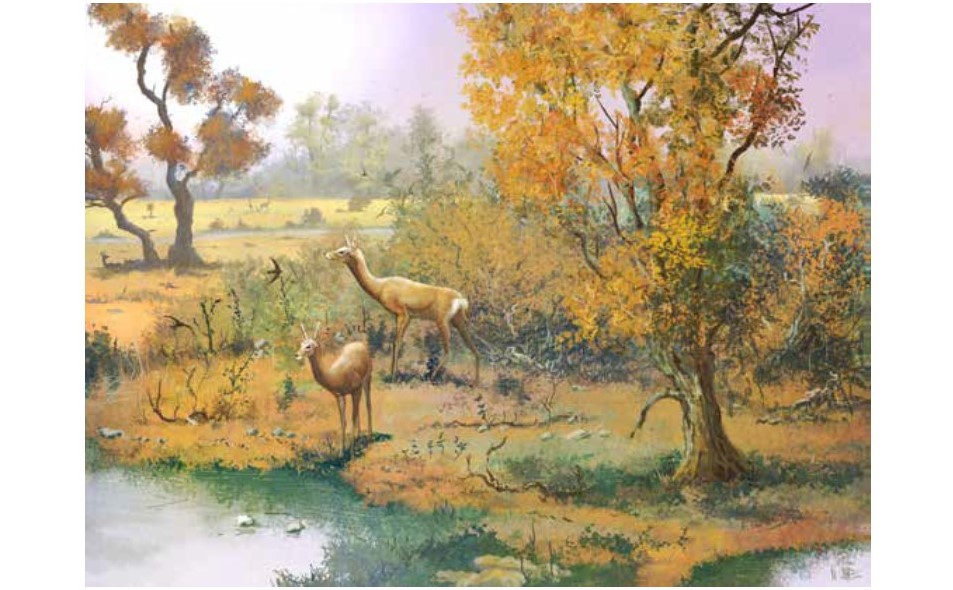
© Copyright Mark Witton 2019
This reconstruction has been reproduced by kind permission of the very talented palaeoartist Mark Witton whose work you can read about, support and buy.
Last edited on 3 July 2026
Registered Charity 1165231 (England and Wales)
© Copyright Friends of Crystal Palace Dinosaurs, 2013-2026. Privacy policy.
Hosted on a server powered by 100% renewable energy.
 Follow us on Bluesky
 Like us on Facebook