
6 October 2022

Michelle Johansen, Interpretation Manager, Bishopsgate Institute
This blog post uses information from works in the reference library at Bishopsgate Institute to discover who visited the Crystal Palace and its ‘extinct animals’ in the nineteenth century.
There are plenty of pamphlets and books on the Crystal Palace in the London Collection at Bishopsgate Institute. These items document the palace’s original incarnation at the 1851 Great Exhibition in Hyde Park, as well as its move to Sydenham in suburban south London.
The Palace (1854) is a slim pamphlet written by the art critic John Ruskin. It provides coverage of the fabulously lavish opening ceremony in June 1854, and includes information on the outfits worn by the female guests. Green mantles. Bright yellow skirts. Lilac dresses. Pink bonnets. Leghorn straw hats.
Ruskin was observing London’s middle and upper classes, the fashionable elite invited to attend the grand opening event. These wealthy men and women were also able to afford the relatively steep price of a season ticket to attend the Palace and its elaborately laid-out gardens as and when they chose throughout the year. This non-transferable ticket belonged to a City businessman. It cost the equivalent of one week’s pay for the average working man.
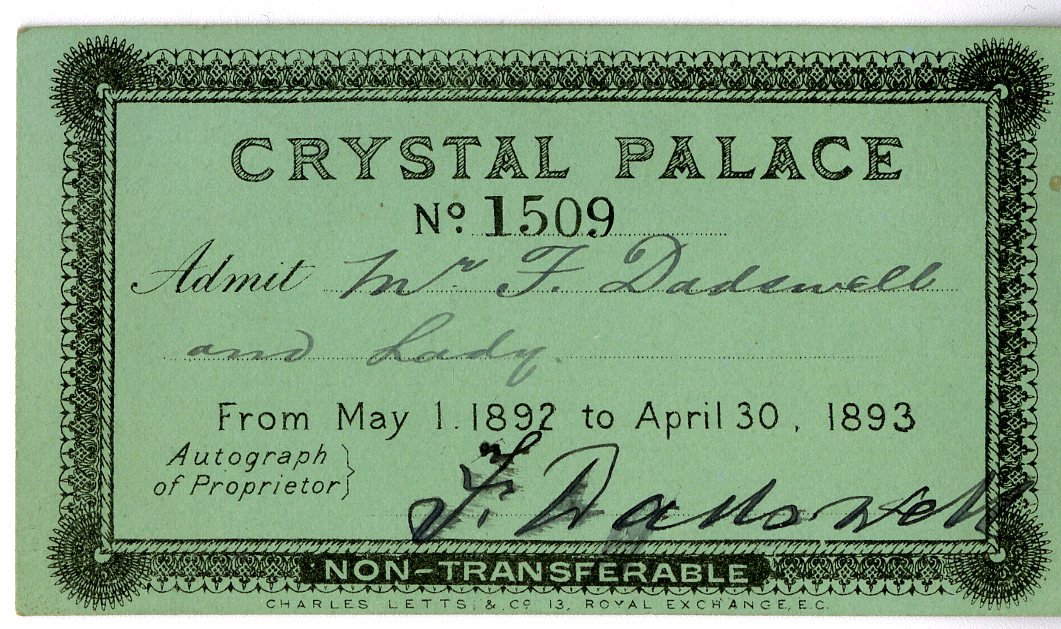
Dadswell Collection, Bishopsgate Institute and Archive
Yet guidebooks make much of the accessible character of the Crystal Palace. W.T.Stead’s Our Fairy Palace. A Child’s Guide (1911) reminds young Londoners that the attraction ‘is yours to enjoy, to use, and to amuse yourself with as much as it is the King’s or the Lord Mayor’s.’ Facts About the Crystal Palace (1891) insists that the palace and its gardens are aimed at the delight of ‘all classes… from the highest in the land to little workhouse children.’ London as it is Today (1856) claims there is no need to possess wealth to enjoy the Palace and its park, before listing the prohibitively steep charges to gain admission.
Children under 12 may have been allowed in at half price, but it still cost a Victorian family of two adults and four children twenty shillings just to enter the 200-acre site. This amount was roughly comparable to the weekly wage of a labourer in full employment. Once beyond the gates, most of the attractions came at a price. Even buying a programme to discover what was happening, and whereabouts to find it within the vast grounds, was an additional expense.
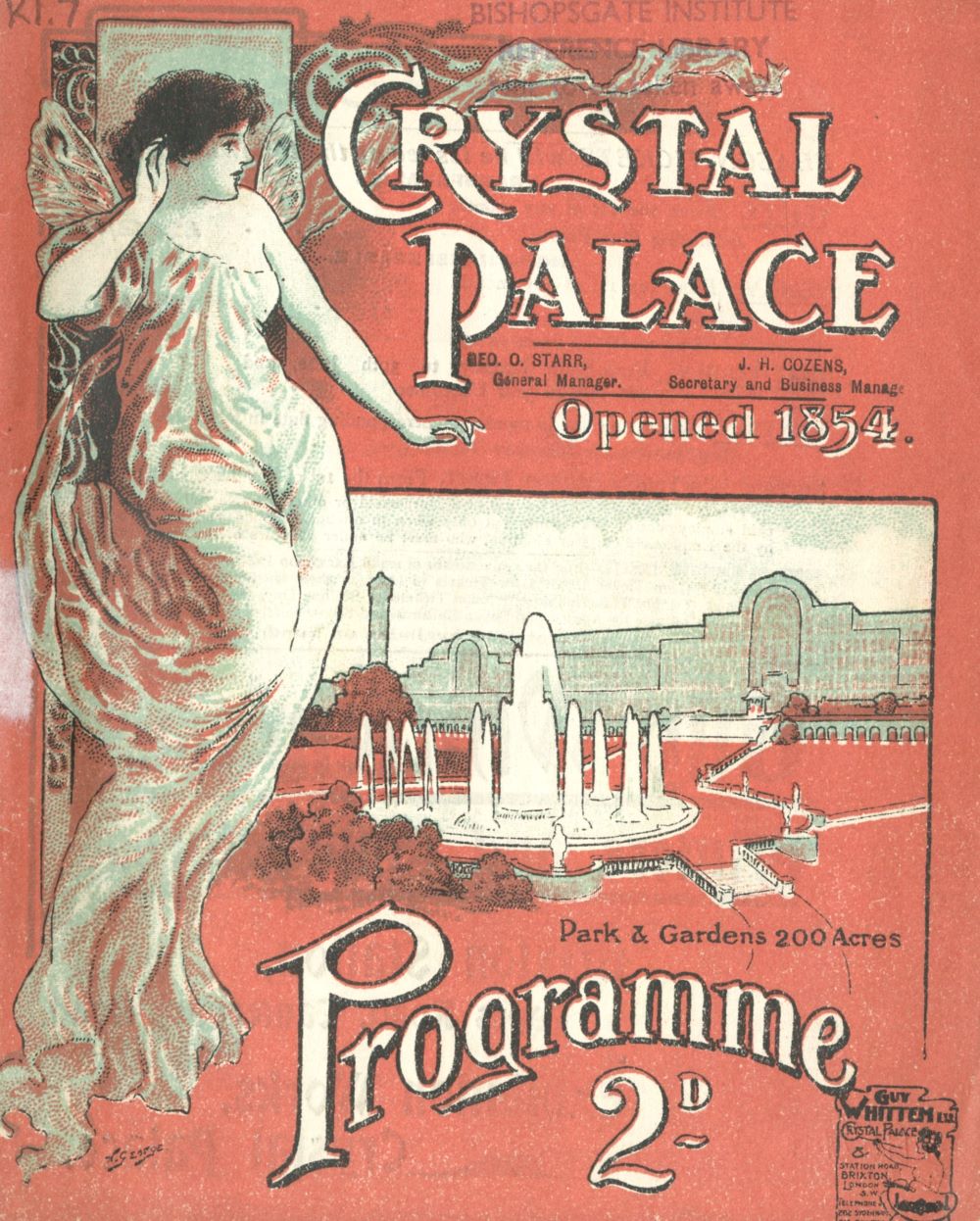
London Collection Pamphlets, Bishopsgate Institute and Archive
This colourful programme from 1907 announces the Crystal Palace as A PEOPLE’S PLEASURE PARADISE but ‘the people’ needed to dig deep into their pockets to enjoy the full visitor experience. A trip on the topsy turvy railway (below) cost sixpence. A slide on the helter skelter was tuppence. Watching the motor car racing in the novelty court was another tuppence. Each adult passenger paid thruppence to voyage in an electric canoe through caves and grottoes on the lake.
Taking in a performance in the North Tower Gardens demanded yet more outlay. Tickets to the Egyptian Harem (promising ‘genuine oriental songs and dance’) cost thruppence. Visitors paid another thruppence for the privilege of getting lost in the maze between the cycle track and the lake. Inside the palace itself, yet more add-ons arrived in the shape of charges to play miniature billiards, take part in silhouette cutting, view the camera obscura, and so on. Food and drink, of course, constituted another expense.
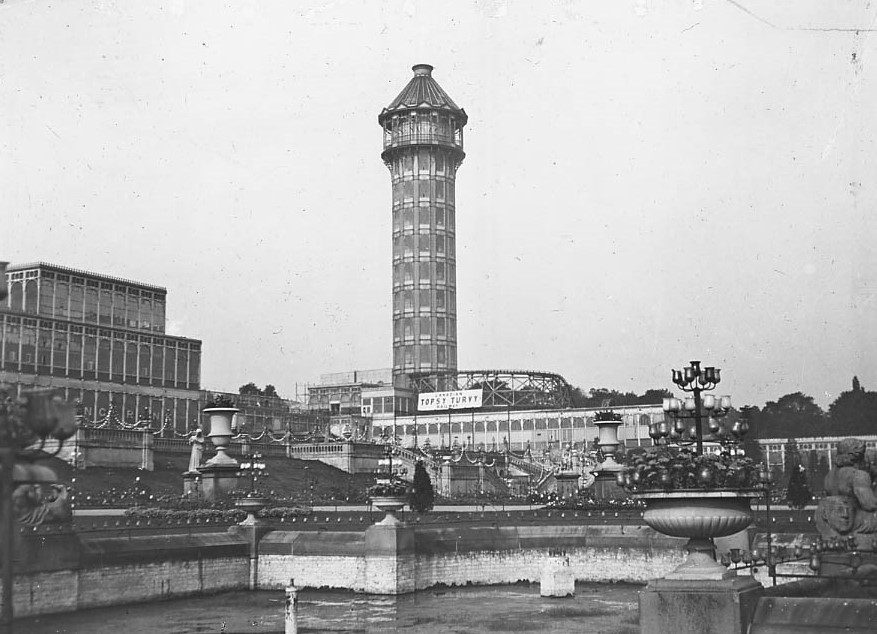
The topsy turvy railway beside the North Tower Gardens at the opposite end of the park to the dinosaurs (LAMAS/G220, Bishopsgate Institute and Archive)
Around two million people visited the Crystal Palace every year during the second half of the nineteenth century. From the novels of George Gissing and H.G.Wells, we know the Victorian working and lower-middle classes were among their number. These visitors would arrive early with a picnic and remain at the Palace until the site closed, which might be as late as 11pm in the summer.
Once inside, they took advantage of the free attractions on offer, including live music at bandstands across the site, distant views of extraordinary firework displays, and of course the opportunity to admire the full scale, three dimensional prehistoric creatures – the enormous Crystal Palace dinosaurs lurking among the trees on an island on the tidal lake down by the Anerley entrance.
You can discover more about the history of the Crystal Palace on Michelle’s online course on Saturday 22 October or by visiting the library at Bishopsgate Institute to explore the guidebooks and pamphlets on the subject as an independent researcher. There’s no need to book your visit and no membership is required.
Top image: The New Crystal Palace Sydenham, Grand Entrance, pub. 1854, Augustus Butler
Registered Charity 1165231 (England and Wales)
© Copyright Friends of Crystal Palace Dinosaurs, 2013-2026. Privacy policy.
Hosted on a server powered by 100% renewable energy.
 Follow us on Bluesky
 Like us on Facebook