
21 October 2022

Dickens by Watkins, 1858. Wikimedia Commons.
The Friends of Crystal Palace Dinosaurs love nothing more than solving a good mystery and uncovering the history of the Crystal Palace Dinosaurs – and this month we discovered a corker!
The Geological Court gained international acclaim in the nineteenth century and we had always suspected that the writer Charles Dickens may have visited Crystal Palace Park in 1853, given his heyday was contemporaneous with its construction, but this was always just a hunch.
Then just last month one of our eagle-eyed volunteers Alexandra found an extract from an article that Dickens wrote in a recent book by Laurence Talaraich called Animals, Museum Culture and Children’s Literature in Nineteenth-Century Britain: Curious Beasties (Palgrave Macmillan, 2021) in Chapter 6 ‘Prehistoric Beasties’.
The excerpt was from an article written by Dickens from a publication called Household Words. Dickens was the publisher, editor and a major contributor to this weekly journal from 1850-1859.

Our trustee Sarah then managed to track down the article that was published on 3rd December 1853. In it Dickens described visiting Crystal Palace Park in elaborate, creative prose, with one glorious section clearly depicting visiting Benjamin Waterhouse Hawkins’ workshop, where all the sculptures were being constructed. We have included the entire extract below, and you can link to the whole piece here.
However, we didn’t stop there. In order to bring it to life we asked our fabulous friend, actor Tom Goodman-Hill, to be the voice of Dickens in a special, one-off recording of his words.
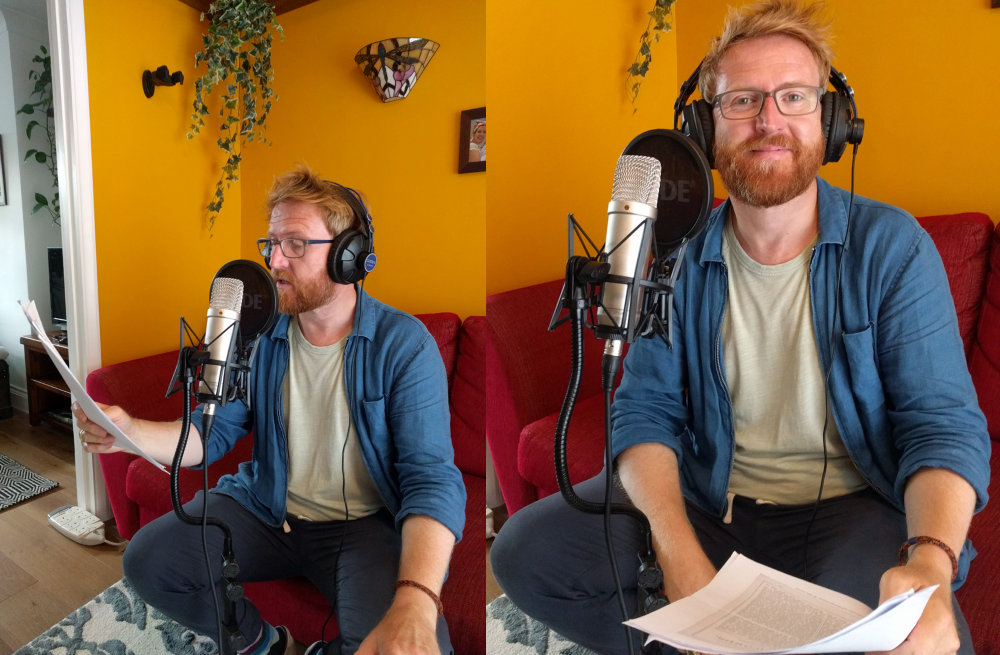
Thank you so much to Alexandra, Sarah and Tom for all their work and we hope you enjoy the video as much as we did making it!
While admiring the vastness of the gardens, the vivid beauty of the velvety sward, the taste with which every path and plot, every alley and avenue have been laid out; while gloating over the blue distance of the most beautiful landscape near London, I cannot help wishing that the weather had not been quite so moist lately; that the fairy soil was not quite so stiff in some parts and so sloppy in others; and finally that I had not forgotten to bring American overshoes or a pair of mudlark’s boots with me to Fairyland.
But what are these trifling thorns to the rose, when we approach the terminus of our walk; which is through a wood, and across several planks over gulleys, and through many morasses, quagmires, cart-ruts and ditches? We are bound for, and at last arrive at a long low shed, where there is a furnace, several tons of modelling clay, several modellers, a book for us to sign our autographs in, an astute Triton in hessian boots and low-crowned hat (possibly his conch-shell), several rats, and finally the world before the flood.
The world before the flood. Yes. Ages, perhaps, before Noah’s ark was built, or launched, or thought of. In this shed the Triton known as Waterhouse Hawkins has conspired with the King of Animals, Professor Owen, to bring back those antediluvian days where there were giants in the land. Pre Adamite, perhaps; pre-Noahite, certainly. Modelled according to some subtle theory, admirably carried out into practice; the marvels of what we may call scientific art - plasticity applied to comparative anatomy - are the great monsters and reptiles of the fossil world.
The ichthyosaurus, the plesiosaurus, the megatherium, the mastodon, igua-arneton; gigantic creatures of lizard, toadlike, froglike, beastlike form grin at you, crawl at you, wind their hideous tails round you. Here is a monster within whose monstrous feet the Triton, Waterhouse Hawkins intends to give a dinner to twenty-two persons; and a bearded assistant, coolly squatted between the monster’s forelegs, is as coolly giving him a coat of scales with his modelling tool.
All these antediluvian monsters, which will finally be executed in a composition as hard as stone, will be placed on the shores of two artificial islands in the lake; one exhibiting the secondary, the other the tertiary epochs of the world. There, among reeds and slime, the great fish lizards crawl, and higher up the great Irish elk reposes. All of which is explained to us in a little studio, where sepia sketches of elks and mastodon, and megatheria mingle with clay sketch models and casts of skulls and femurs of fossil mammalian and reptiles.
From Charles Dickens, ‘Fairyland in fifty-four’, Household Words , 193 (3 December 1853): 313–17.
Registered Charity 1165231 (England and Wales)
© Copyright Friends of Crystal Palace Dinosaurs, 2013-2026. Privacy policy.
Hosted on a server powered by 100% renewable energy.
 Follow us on Bluesky
 Like us on Facebook